On a recent Q&A episode of the 9 to 5 Wellness podcast, a listener named…
VO2 Max and Longevity- Why Aerobic Capacity Is the Ultimate Longevity Biomarker
Most people want the same thing as they get older: to keep feeling capable, energetic and independent for as long as possible. They want to hike, travel, play with their grandkids and keep up with their careers well into later life.
If one number captures how likely that is, it’s VO2 max. It’s also called aerobic capacity, and research ties it directly to how long and how well people live. That makes it one of the most powerful longevity biomarkers in health science.
This guide covers what VO2 max is, why it matters for longevity, what a healthy range looks like and how to improve it.
What is VO2 max?
VO2 max is the maximum amount of oxygen your body can take in, transport and use in one minute during intense exercise. It measures how efficiently your body absorbs oxygen and puts it to work when you’re pushing hard.
Your body needs oxygen all the time, even at rest. Once you start moving, whether that’s walking, climbing stairs or exercising, the demand goes up. The harder you work, the more oxygen you need.
Oxygen makes aerobic energy production possible. (“Aerobic” means “with oxygen.”) Oxygen lets your body turn the energy stored in carbohydrates and fats into ATP (adenosine triphosphate), the fuel your muscle cells actually use. That’s why VO2 max is also called your aerobic capacity: it’s the upper limit of your body’s ability to produce energy with oxygen.
Exercise physiologists have studied how the body uses oxygen for more than 100 years. VO2 max isn’t a trendy wellness metric. It’s one of the most thoroughly researched measures in exercise science.
Why VO2 max is more than a fitness number
VO2 max is known as a performance metric for endurance athletes like runners, cyclists, triathletes and cross-country skiers. (Elite cross-country skiers hold some of the highest VO2 max values ever recorded.) But it matters just as much for people who have never run a race.
VO2 max reflects how well several major systems work, both on their own and together:
- Your heart, which pumps oxygen-rich blood
- Your lungs, which pull oxygen from the air
- Your circulatory system, which carries oxygen through the body
- Your muscle cells, which take up oxygen and turn it into energy
A higher VO2 max means your body is better at getting oxygen from the air to your muscles. More oxygen means more ATP, and more ATP means more energy for everything from a hard workout to a long workday.
The link between VO2 max and longevity
Why do researchers call aerobic capacity a longevity biomarker? Because of the size of its link to mortality.
A large study published in JAMA Network Open (Mandsager et al., 2018) followed more than 122,000 patients who took treadmill exercise tests. Patients with higher cardiorespiratory fitness had a much lower risk of death from all causes, not just heart disease. Patients with the lowest fitness levels had the highest risk.
Researchers call this all-cause mortality, and it’s about as strong a longevity signal as exercise science offers. In this data, low aerobic fitness carried a mortality risk comparable to or greater than well-known risk factors like smoking and diabetes.
Research points to a clear conclusion: people with a higher VO2 max tend to have lower cardiovascular risk and to live longer, healthier and more functional lives. The goal isn’t only to add years to life. It’s to stay strong and capable during those years.
What is a good VO2 max?
For competitive endurance athletes, the answer is simple: as high as possible. VO2 max is a key competitive edge, and elite athletes build their training around it.
For everyone else, VO2 max is best read against normal ranges. Four main factors shape those ranges:
- Age: VO2 max naturally declines with age.
- Biological sex: Men typically have higher values than women.
- Current fitness level: This is the factor you can change the most.
- Elevation: People who live and train at altitude, such as in Colorado, tend to have higher values.
You can’t control age or sex. Fitness level is the big lever almost anyone can pull.
General VO2 max benchmarks
VO2 max is measured in milliliters of oxygen per kilogram of body weight per minute (mL/kg/min).
| Fitness level | Men (mL/kg/min) | Women (mL/kg/min) |
| Sedentary | 35–40 | 27–30 |
| Active | 42–46 | 33–36 |
| Elite/professional athlete | 75+ | 70+ |
These are general ranges. Age-specific norms give a more precise picture of where an individual stands.
How to test your VO2 max
There are several ways to find out your VO2 max:
- University sports performance labs: Many universities with exercise science programs offer VO2 max testing, sometimes for free.
- Cardiopulmonary exercise testing (CPET): Doctor’s offices, longevity clinics and hospital exercise medicine labs offer this test for a fee.
- Smartwatches and fitness trackers: Many wearables estimate VO2 max. They’re less precise than lab tests but useful for tracking trends over time.
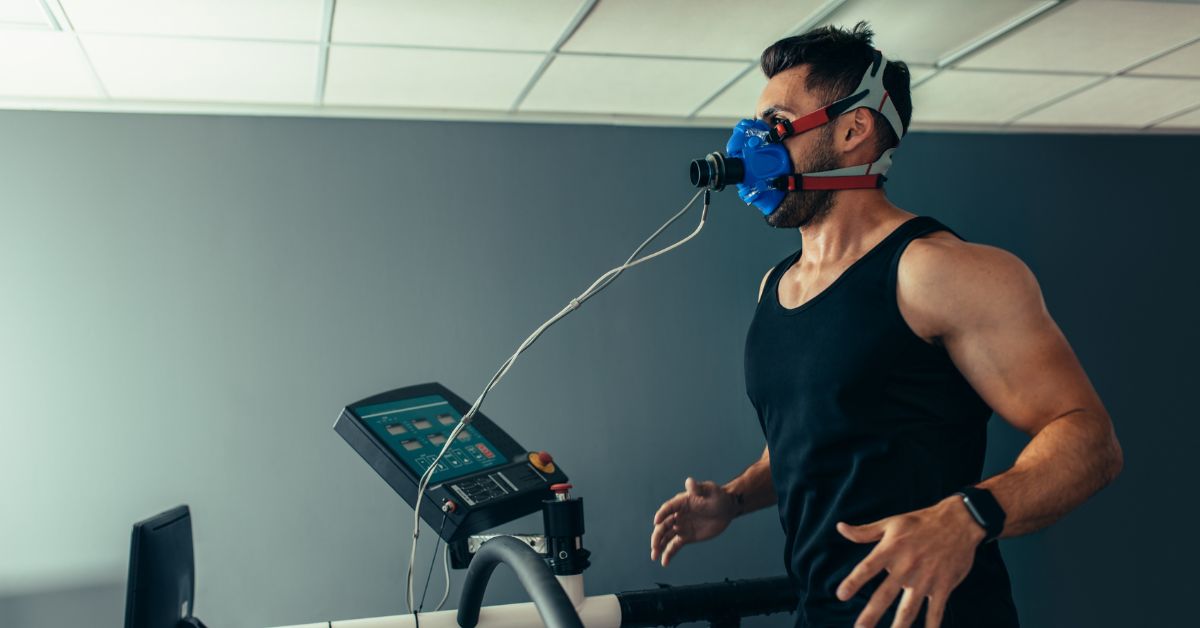
In a lab test, you wear a mask that measures the oxygen and carbon dioxide you breathe while running or cycling at increasing intensity. A common method is the Bruce protocol, a treadmill test that raises the speed and, especially, the incline at set intervals until exhaustion.
It’s a real max-effort workout. Take the test only when you’re healthy, ideally with an exercise physiologist supervising.
3 proven ways to improve aerobic capacity
VO2 max can improve with consistent, targeted training, often within a few months. These three strategies work best together.
1. High-intensity interval training (HIIT)
HIIT alternates short bursts of hard aerobic effort with recovery periods. Just one quality HIIT session per week can raise VO2 max.
- Classic format: 4 minutes hard, 4 minutes easy recovery, repeated
- Beginner format: 1 minute hard, 90 seconds recovery, building up over time
HIIT works at almost any fitness level. Build up gradually rather than going all-out on day one.
2. Zone 2 training
Zone 2 is easy, steady cardio at a pace where you can still hold a conversation. Running, cycling, hiking, rowing and ski machines all count.
- Aim for 30–40 minutes at a low, conversational intensity.
- Breaking it into intervals (for example, 5 minutes on and 2 minutes off) works too.
Zone 2 is far less stressful on the body than HIIT, so the two pair well. Alternating hard HIIT days with easy zone 2 days builds a strong aerobic base without burnout.
3. Improve body composition
This one surprises many people. VO2 max is measured relative to body weight, so body composition directly affects the number. Lowering body fat while keeping lean muscle helps your muscles use the oxygen they receive more efficiently.
The focus isn’t a number on the scale. It’s body composition, and it works alongside the training strategies above.
Sample workouts to boost VO2 max
Two proven workouts for people ready to push their aerobic capacity:
- 1,000-meter or mile repeats
- 4 × 1,000 meters (or 4 × 1 mile) at 5K race pace
- 3 minutes of full recovery between reps
- Hill repeats
- 2 minutes of hard uphill running
- Jog or walk back down to recover
- Repeat 6–8 times, letting your heart rate settle before each climb
- Start with as much recovery as you need, then shorten it over the following weeks and months
The bottom line
VO2 max isn’t just a number for marathoners and triathletes. It’s one of the strongest longevity biomarkers there is, and one of the few you can meaningfully improve at almost any age.
Higher aerobic capacity is linked to lower all-cause mortality, lower cardiovascular risk and more years of feeling strong and capable. Weekly HIIT, regular zone 2 training and attention to body composition can move the number, often faster than people expect.
Ready to improve your VO2 max? Listen to the full episode, VO2 Max: Your Ultimate Longevity Biomarker, on the 9 to 5 Wellness podcast. For a personalized plan, [work with a clinical exercise physiologist].
This article is for educational purposes only and isn’t medical advice. Talk to your healthcare provider before starting a new high-intensity exercise program or taking a max-effort fitness test.
🔬🧪👩🔬Related Research Studies
VO2 max ageing and all cause mortality
The Role of VO2 max as an Indicator of Population Health
📚📖Books on the Topic
Outlive: The Science and Art of Longevity by Peter Attia, MD (2023)
80/20 Running by Matt Fitzgerald (2014)
This post was originally a 9 to 5 wellness podcast.
Related Posts